Custom Boat & Marine Parts Manufacturer — Deck Hardware & Fittings
Corrosion-resistant marine hardware and components, custom manufactured for boats and marine equipment.
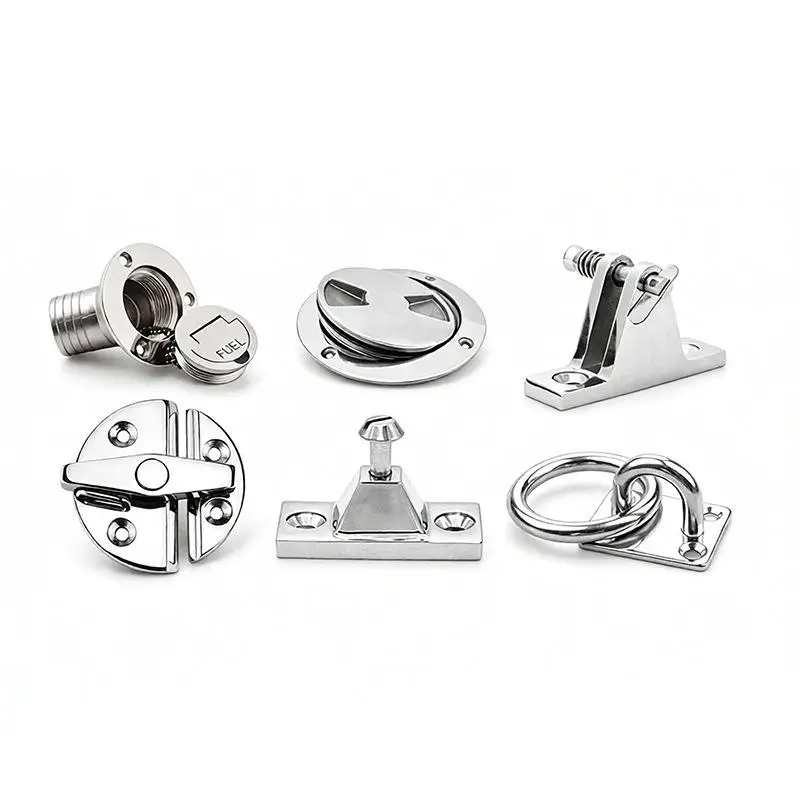
We manufacture boat hardware and marine components in marine-grade materials — deck fittings, cleats, hinges, latches, rail components and fasteners. Material and finish are selected for the exposure the part will actually see, and every batch is inspected before packing.
Boat & Marine Parts Manufacturing: Scope & Capabilities
We are a custom marine parts manufacturer working with boat builders, marine equipment manufacturers, distributors and refit yards. We turn a defined requirement — a drawing, a corroded original, or a new product concept — into production batches that hold their specification.
Marine hardware is the most demanding category we work in, because the failure mechanism is continuous rather than occasional. A boat part is never dry. It is either in saltwater, in salt-laden air, or drying with salt deposits on its surface. Material selection is therefore the primary engineering decision, and finishing is the secondary one.
Categories We Manufacture
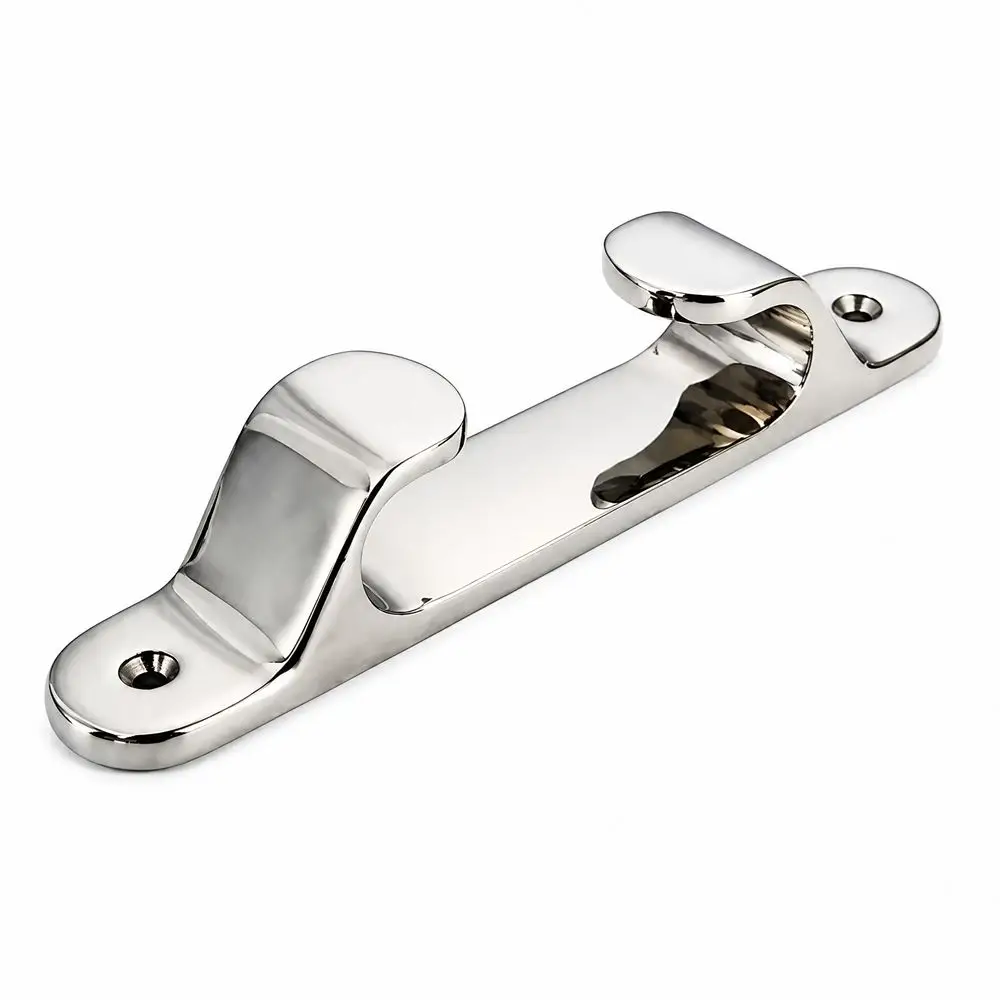
- Deck hardware — cleats, fairleads, chocks, bollards and deck fittings
- Hinges, latches and handles — cabin, locker and hatch hardware
- Rail components — rail fittings, stanchion bases, tube connectors and brackets
- Structural fittings — mounting brackets, backing plates and reinforcement components
- Fasteners — marine-grade screws, bolts and threaded components
How a Custom Marine Part Program Runs
- You send a drawing, CAD file, physical sample or a corroded original part.
- Our engineers review the application and propose material grade, finish and tolerance.
- We prototype so you can verify fit on the deck, cabin or rail assembly.
- Production runs with in-process checks at defined stages.
- Every batch passes final inspection against your approved sample before packing and export.
Where an original part has failed in service, we review the failure as part of the quotation — the reason a cleat cracked or a hinge seized usually changes the material recommendation.
Saltwater, UV and Time: Why Marine Hardware Fails
Almost all marine hardware failure traces back to one of three mechanisms. Understanding which applies to your part determines the material and finish, so it is worth being explicit about it.
Crevice Corrosion
Where two surfaces meet and water can enter but not circulate — under a bolt head, inside a joint, behind a gasket — oxygen is depleted and stainless steel loses its passive layer. Crevice corrosion typically appears as pitting or a rust stain at a joint rather than on an exposed surface.
The practical response is design-led as much as material-led: avoiding tight crevices where possible, specifying a higher-alloy grade for joints, and choosing a finish that keeps surfaces passivated.
Galvanic Corrosion
When two dissimilar metals are in contact in an electrolyte, the less noble metal corrodes preferentially. This is a common cause of failure on boats, where stainless fittings are bolted to aluminum structures or where an inappropriate fastener is used in a fitting.
The response is to control the metal pairing deliberately, use isolating washers or coatings where dissimilar metals must meet, and specify fasteners compatible with the component they hold.
UV Degradation
Sun exposure degrades plastics, coatings and sealants. On a boat this happens at the same time as salt exposure, so a material that handles one may still fail the other. UV-stabilized engineering plastics are available for exposed non-metallic components.
Stress Corrosion Cracking
Sustained tensile stress in a corrosive environment causes cracking well below the material’s normal strength. This is why sharp threads, tight bends and over-torqued fasteners are risk points on marine hardware, and why we review geometry rather than only material grade.
Marine Hardware We Manufacture
| Component group | Typical process | Common application |
|---|---|---|
| Deck cleats, fairleads and deck fittings | Casting, machining, polishing | Mooring, line routing, deck operation |
| Marine-grade hinges and latches | Die casting, machining, assembly | Cabin doors, lockers, hatches |
| Rail fittings and stanchion bases | Machining, casting | Guard rails, handrails, tube structures |
| Mounting brackets and structural fittings | CNC machining, forming | Equipment mounting, structural attachment |
| Marine fasteners | Machining, cold forming | Assembly, deck fitting attachment |
Deck Cleats, Fairleads & Deck Fittings
Deck hardware carries mooring and operational loads while permanently exposed. We produce cleats, fairleads, chocks and deck fittings in cast and machined 316 stainless steel with polished or satin finishes. See our marine deck cleats and fairleads for the standard component range.
Marine-Grade Hinges & Latches
Hinges and latches are the most frequently operated parts on a boat, and the most likely to seize. We produce cabin, locker and hatch hardware in stainless steel 316, die-cast and machined, with finishes selected for appearance and for crevice resistance. See our marine-grade hinges and latches for the standard range.
Rail Fittings & Stanchion Bases
Rail structures combine structural load with continuous exposure. We machine and cast rail fittings, stanchion bases and tube connectors, with attention to how water drains from the assembly — a fitting that traps water will fail before one that does not.
Mounting Brackets & Structural Fittings
Where equipment mounts to a boat structure, both the bracket and the fastening interface must resist galvanic corrosion. We produce brackets and structural fittings in stainless steel and aluminum, and specify isolating hardware where dissimilar metals meet.
Marine Fasteners
Fasteners are the most common point of marine hardware failure. We manufacture marine-grade screws, bolts and threaded components, and can advise on the correct grade for the fitting they hold rather than supplying a generic stainless fastener.
Material Selection for Marine Environments
| Exposure | Recommended material | Notes |
|---|---|---|
| Continuous saltwater contact | 316 / 316L stainless steel | Molybdenum content resists chloride pitting |
| Splash and spray zone | 316 stainless steel | Standard for deck hardware and fittings |
| Sheltered but humid | 304 stainless steel | Adequate where chlorides are limited |
| Above-deck non-structural | Anodized aluminum | Light, corrosion-resistant, colorfast |
| Decorative and interior | Brass, bronze | Traditional appearance, requires maintenance |
| Non-metallic components | UV-stabilized engineering plastics | Handles UV, avoids galvanic issues |
316 Stainless Steel
Type 316 is the default for marine hardware. Its molybdenum content gives it substantially better resistance to chloride pitting and crevice corrosion than type 304, which is why it is specified for deck fittings, fasteners and anything that stays wet.
304 Stainless Steel — When It Is Enough
Type 304 performs adequately in sheltered, humid conditions where chlorides are limited — interior fixtures on freshwater boats, for example. It is not the right choice for permanent deck exposure, and it is a common cause of premature rust staining when substituted for 316 to reduce cost.
Aluminum, Brass and Engineering Plastics
Anodized aluminum suits above-deck components where weight matters, though it must be isolated from stainless steel to prevent galvanic corrosion. Brass and bronze give a traditional appearance and are chosen for aesthetic reasons, accepting more frequent maintenance. UV-stabilized engineering plastics handle exposure without galvanic risk, which makes them useful for components that interface with mixed metals.
Surface Finishing for Marine Hardware
| Finish | Appearance | Corrosion contribution |
|---|---|---|
| Mirror polishing | Bright, reflective | Smooth surface sheds water and resists deposit build-up |
| Electropolishing | Bright, uniform | Removes surface contamination, strengthens the passive layer |
| Satin / brushed | Matte directional | Practical finish, less demanding to maintain |
| Passivation | Unchanged | Chemical removal of free iron after machining |
| Anodizing (aluminum) | Satin to matte, colored | Protective oxide layer for aluminum components |
| PVD coating | Color-stable, hard | Decorative and wear-resistant on visible hardware |
Mirror Polishing
Polishing produces a smooth surface that sheds water and resists the deposit build-up that initiates crevice corrosion. It is the standard finish for visible deck hardware, and also has a functional benefit beyond appearance.
Electropolishing
Electropolishing removes surface contamination left by machining and strengthens the passive layer of stainless steel. Where a component will be permanently exposed, it is often the more durable choice than mechanical polishing alone.
We do not publish salt-spray hour figures, because performance depends on the specific grade, finish and geometry of your component. Tell us the exposure and we will specify accordingly.
How a Custom Marine Part Program Runs
Matching Existing Deck Hardware
Replacing a single fitting without replacing the rest is one of the most common marine requests. We replicate hardware from samples or drawings and match finishes by reference, so a replacement component sits alongside original fittings without an obvious mismatch.
New Build and Production Programs
For boat builders, we support the full path from design review through prototyping, tooling and volume production. Because model runs in boatbuilding are typically short, low MOQ and fast prototype turnaround are the practical requirements.
We support OEM manufacturing from your drawings, ODM where we develop the product for you to rebrand, and prototype development for new programs.
Who We Supply
- Boat builders and marine equipment manufacturers specifying hardware for new models
- Marine distributors and chandlers building their own label hardware ranges
- Refit yards and service companies needing replacement and one-off components
- Importers sourcing marine-grade hardware for regional markets
Founded in 2006, we operate a 1,350㎡ facility with a 28-person team including 12 engineers, producing over 6,000,000 pieces a year for customers in more than 40 countries and regions. Our quality management system is ISO 9001:2015 certified.
Buying Guide: Sourcing Marine Hardware
Confirm the material grade in writing, not by description. “Marine stainless” is not a specification. A supplier should state the grade — 316, 316L, 304 — and be willing to provide a material certificate. Substituting 304 for 316 is the single most common cause of premature staining on new hardware.
Ask about the crevice points in your design. Where the part has joints, bolt interfaces or press fits, ask how the design avoids trapped water. Crevice corrosion is a design outcome, not bad luck.
Check how dissimilar metals are handled. If your component meets aluminum, or if a stainless fastener will be used in a stainless fitting, ask about isolating washers or coating. This is where galvanic failure is prevented or designed in.
Verify the finish does more than look right. Mirror polishing and electropolishing both improve corrosion performance, not only appearance. Ask which is being applied and why.
Test the first production batch, not only the sample. Marine failures often appear weeks after installation. Confirm that the finish quality and material grade of the production batch match the approved sample.
FAQ
Should I specify 316 or 304 stainless steel? Type 316 for anything that stays wet, sits on deck, or is exposed to saltwater and coastal air. Type 304 is acceptable for sheltered interior applications on freshwater boats or in low-chloride environments. The cost difference is small relative to the cost of replacing corroded hardware.
How do you prevent crevice corrosion? Partly through material and partly through design. We specify a higher-alloy grade such as 316 for components with joints, and we review geometry to avoid tight gaps where water can enter but not circulate. Electropolishing also helps by removing surface contamination that initiates pitting.
What happens if stainless steel contacts aluminum on my boat? The aluminum becomes the anode and corrodes preferentially. Where the two must meet, the interface should be isolated — with an isolating washer, a coating, or a non-metallic barrier — and the fasteners chosen with the metal pairing in mind. Send us the assembly and we will advise on the interface.
Does electropolishing actually improve corrosion resistance? Yes. Electropolishing removes surface contamination and free iron left by machining and strengthens the passive oxide layer on stainless steel. For permanently exposed components it usually performs better than mechanical polishing alone, and it also produces a more uniform appearance.
Can you match hardware already fitted to my boat? Yes. We replicate hardware from samples or drawings and match finishes by reference. This is common when one fitting is replaced rather than the whole set, and finish matching is verified on the prototype.
How often should marine hardware be inspected? That is a maintenance decision for the operator rather than a manufacturing one, and it depends on the environment. What we can do is reduce the number of inspection-critical points by designing out crevices and specifying grades that resist the conditions the hardware actually sees.
Which finish is best for deck hardware? Mirror polishing or electropolishing for visible deck fittings, because both improve water shedding and corrosion performance alongside appearance. Satin and brushed finishes are practical alternatives where a less reflective look is wanted, though they demand slightly more maintenance to stay clean.
Do you accept low-volume orders for a refit or a single boat? Yes. Low MOQ and one-off production are viable for refit and replacement work. Send the sample or drawing and we will confirm what is practical for your specific component.
Related Products
- Marine Deck Cleats & Fairleads — 316 stainless deck hardware
- Marine-Grade Hinges & Latches — cabin, locker and hatch hardware
Related Applications
Marine hardware falls under marine and yacht applications, where saltwater exposure and UV are the defining conditions, and is frequently specified alongside private-label programs where the customer’s own brand is applied to finished fittings.
Related Resources
- Materials Guide for Automotive & Marine Parts — how aluminum, stainless steel and plastics compare
- How Custom Vehicle Parts Are Made — the process from design review to delivery
- How to Choose a Custom Car Parts Manufacturer — an evaluation checklist that applies to any vehicle line
Request a Quotation
Send your drawing, a sample or the failed original part, and tell us the exposure — deck, below deck, splash zone or sheltered interior. We will specify the material grade and finish for that condition, then quote.
Request a quote — or attach your files using the form on this page. We reply within 24 hours on business days.
Request a quotation
Send your drawing or sample and our engineering team will respond within 24 hours with a quotation.
- Engineering review within 24 hours
- Free DFM (design-for-manufacturability) feedback
- NDA available on request
Your data is encrypted in transit and never shared with third parties.